Short answer: look for the amount of each active ingredient per chew or scoop, a daily amount by your pet’s weight, a full inactive ingredient list, a lot number and an expiry date. The NASC Quality Seal shows the company passed a quality audit, not that the product works. Skip anything with xylitol or disease claims.
Pet supplement labels look like human supplement labels, but the rules behind them are different, and the front of the bag tells you little. The useful information sits in the small print: what each chew contains, how much your pet should get, and who stands behind the product. This guide walks through each part of the label, using labels we read for our checked guides.
Our checked picks for dogs
Supplements ranked by NASC seal, label doses and recall checks: fish oil · joint supplements · allergy chews · probiotics.
Who Checks a Pet Supplement Before It’s Sold?
No one approves a pet supplement before it reaches the shelf. The FDA says there is no “dietary supplement” category for animal products. The 1994 law that created that category for human supplements does not apply to animals, so most pet supplements are sold under FDA enforcement discretion rather than a dedicated set of rules.
The industry’s National Animal Supplement Council (NASC) is drafting an Animal Health Supplement Act to give these products their own legal category, with product registration, adverse event reporting and labeling rules. As of October 2026 the bill had not been introduced; NASC expected that once the next Congress meets in January 2027. Until then, the label and the company behind it are what you have to go on.
The Label, Line by Line
| Label part | What to look for | Red flag |
|---|---|---|
| Active ingredients per serving | Each active listed with its own amount per chew, tablet or scoop | A "proprietary blend" total with no amount for each ingredient |
| Guaranteed analysis | Some liquids and powders use a feed-style panel with minimum amounts (EPA, DHA, glucosamine) | Only crude protein, fat and moisture, with nothing on the actives |
| Directions by weight | A daily amount for each weight band, and a loading period if there is one | One amount for every size of pet |
| Inactive ingredients | A full list: flavors, oils, binders, sweeteners, allergens | Xylitol in anything for dogs; fish or shellfish if your pet is allergic |
| Species | "For dogs" or "for cats", or both stated | A dog product given to a cat, or a human product given to either |
| Claims | Support wording, such as "supports joint health" | "Treats arthritis", "cures allergies" or other disease claims |
| Cautions | When to stop, and to talk to a vet if your pet is pregnant or on medication | No warnings at all |
| Lot number and expiry | Both printed on the pack | Neither, which makes a recall or complaint hard to trace |
| Company and contact | A company name and a phone number or address for questions and problem reports | A brand name only |
Based on the labels we read for our fish oil, joint and allergy guides, the NASC labeling requirements and FDA consumer guidance. Checked November 18, 2026.
Find the Active Amount, Not the Ingredient Name
The single most useful line is the amount of each active ingredient. Two allergy chews from our guide show why. Vetnique Dermabliss lists EPA 90 mg and DHA 60 mg per chew, the omega-3s with the research behind them. Natural Dog Company’s allergy chew lists salmon oil at 100 mg per chew but not how much EPA and DHA that oil supplies. Both say “salmon,” but only one tells you the dose.
The same goes for fish oil. “1,000 mg salmon oil” is the weight of the oil, not of the omega-3s in it. Look for EPA and DHA in milligrams, either per serving or in a guaranteed analysis. On joint chews, watch for blends: one Zesty Paws Hip & Joint flavor we checked gives only a blend total, so you can’t tell how much glucosamine or chondroitin is in each chew.
Work Out the Dose for Your Pet
Research doses are usually given in milligrams per kilogram of body weight, so convert your pet’s weight first: pounds divided by 2.2. Then multiply the per-serving amount by the label’s daily servings for that weight, and divide by the weight in kilograms.
- Weight in kg: a 30 lb dog is about 13.6 kg.
- Daily amount from the label: Natural Dog Company Wild Alaskan Salmon Oil gives EPA 320 mg and DHA 215 mg in two pumps, the label amount for 26–75 lb.
- Per kg: 535 mg ÷ 13.6 kg ≈ 39 mg of EPA + DHA per kg a day.
- Compare with research: a 2025 review found joint studies used roughly 70–130 mg EPA + DHA per kg, so the label amount is a maintenance dose, not a joint-study dose.
- Check the ceiling: the National Research Council’s safe upper limit works out to about 2,600 mg of EPA + DHA a day for a 30 lb dog. Ask your vet before going above the label.
More is not automatically better. High doses of omega-3s can cause stomach upset and affect clotting, and a 2023 recall of an omega-3 supplement for cats and dogs was for possible high vitamin A levels. If your pet takes medication or has a health condition, check the dose with your vet.
What the NASC Quality Seal Means
The NASC Quality Seal is the closest thing pet supplements have to a quality mark. To use it, a company must pass an independent facility audit, keep a written quality manual, report adverse events to NASC’s database, follow NASC labeling rules and accept random testing of its products against label claims. Audit certificates are valid for two years.
The seal shows
The company passed a quality and labeling audit, tracks problem reports, and its products are randomly tested to check they contain what the label says.
It doesn’t show
That a product works, that its dose suits your pet, or that FDA has approved it. A 2022 review of joint products, for example, found clear support for omega-3s but little for glucosamine and chondroitin, which are sold with the seal too.
Check the seal yourself on the NASC member list. Search for the company name, which can differ from the brand: Purina Pro Plan Veterinary Supplements are listed under Nestle Purina Petcare Company. When we checked on November 16, 2026, some well-known supplement makers, such as Nutramax, were not on the list.
Red Flags and Safety Checks
Never for dogs
Xylitol, sometimes listed as birch sugar. The FDA warns it can poison dogs quickly. It turns up in some human supplements, sugar-free products and peanut butters, so don’t share human products.
Claims to distrust
“Cures,” “treats,” “prevents disease,” “vet approved” without a named vet or study, and “clinically proven” without a study of that exact formula.
Check before you buy
Search the brand on the FDA animal recalls list, and keep the lot number until the pack is finished in case you need to report a problem.
If your pet gets sick after a supplement, stop giving it, call your vet, and report it to the company and to the FDA through its Safety Reporting Portal. Lot numbers and expiry dates help the FDA trace the cause.
Questions
Are pet supplements regulated by the FDA?
Only loosely. The FDA oversees animal food and drugs, but it has no separate "dietary supplement" category for animals, and pet supplements are not approved before sale. Most are sold under FDA enforcement discretion. A bill to create a legal category was still being drafted in late 2026.
What does the NASC seal on a dog supplement mean?
The company passed an independent audit of its quality system and labeling, reports adverse events to NASC and accepts random testing of its products against the label. It is not proof the product works or a sign of FDA approval.
What is a proprietary blend on a pet supplement?
A group of ingredients listed with one combined weight. You can see what is in the blend but not how much of each ingredient, so you can't compare doses with research or with other products.
How do I know how much of a supplement to give my dog?
Use the label's daily amount for your dog's weight band, then check the active amount per kilogram against published research or ask your vet. Start at the label amount and don't exceed it without your vet's advice.
Can I give my dog a human supplement?
It's safer not to. Human products are dosed for people and may contain xylitol, which is toxic to dogs, or other ingredients that don't suit pets. Ask your vet if you want to use one.
What should I do if my pet reacts to a supplement?
Stop giving it and contact your vet, or an emergency clinic for severe signs such as collapse or seizures. Keep the package and lot number, and report the problem to the company and to the FDA.
Sources
- Animal Foods & Feeds (no “dietary supplement” category for animals) — U.S. FDA
- Update: Animal Health Supplement Act would give products legal home (Oct 2026) — Petfood Industry
- NASC Quality Seal requirements — National Animal Supplement Council
- NASC Member List and Quality Seal — National Animal Supplement Council
- What it takes to earn the NASC Quality Seal — Pet Age
- Omega-3 fatty acid doses in canine dermatology and osteoarthritis: a review (Vendramini et al., 2025) — Nutrition Research Reviews
- Potential Adverse Effects of Omega-3 Fatty Acids in Dogs and Cats (Lenox & Bauer, 2013) — JVIM
- A 2022 Systematic Review and Meta-Analysis of Enriched Therapeutic Diets and Nutraceuticals in Canine and Feline Osteoarthritis — Int J Mol Sci
- Paws Off Xylitol; It’s Dangerous for Dogs — U.S. FDA
- Animal & Veterinary Recalls & Withdrawals — U.S. FDA
- Stratford Care USA recalls omega-3 supplements for cats and dogs (2023) — U.S. FDA
- How to Report a Pet Food Complaint — U.S. FDA
Update log: November 18, 2026 – First version; label examples from our fish oil, joint and allergy chew guides, NASC member list checked November 16, 2026.
Also checked on the Pets shelf
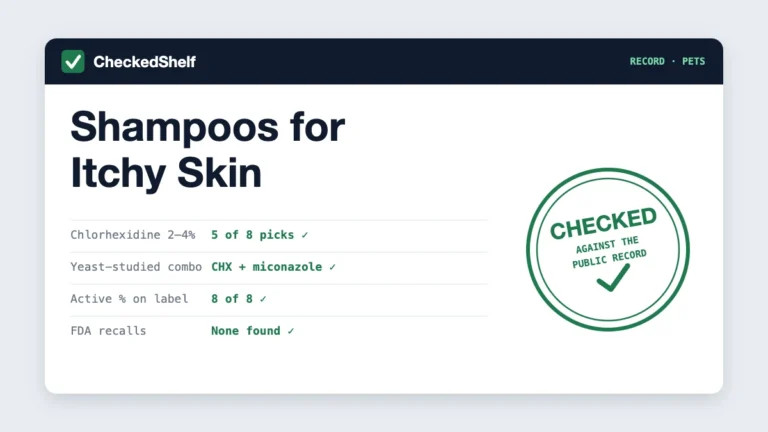
 21 checked → 8 picksBest Dog Shampoos for Itchy Skin of 2026: 8 Picks Checked Against Vet Skin GuidelinesRecords checked Nov 19, 2026
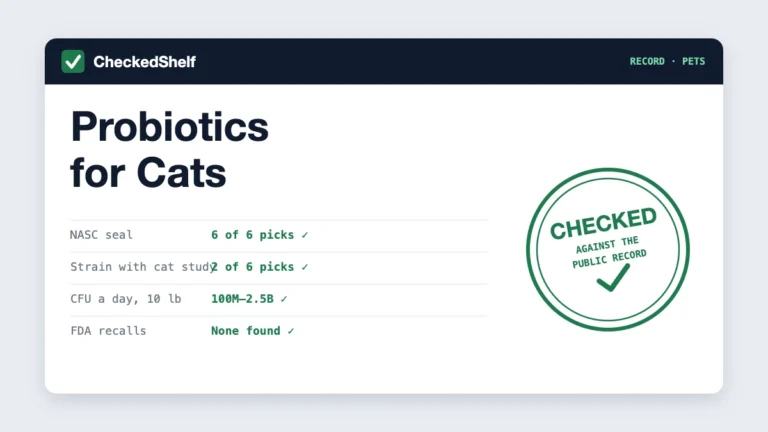
- 18 checked → 6 picksBest Probiotics for Cats of 2026: 6 Picks Checked Against the NASC Seal and Cat StudiesRecords checked Nov 19, 2026
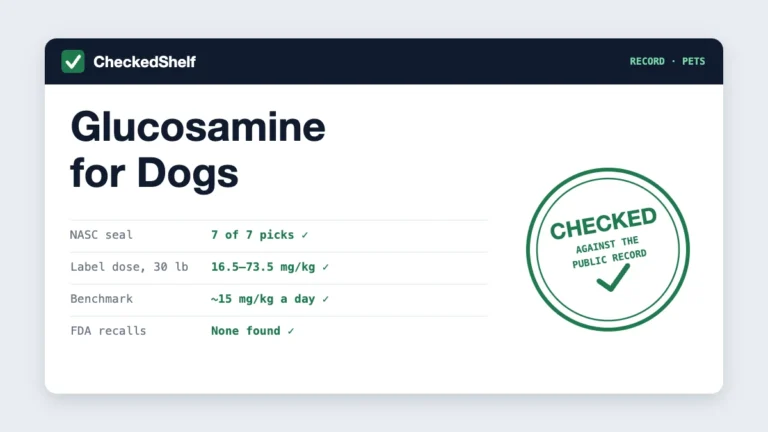
- 16 checked → 7 picksBest Glucosamine for Dogs of 2026: 7 Picks Checked Against the NASC Seal and Study DosesRecords checked Nov 19, 2026