Short answer: NSF/ANSI 42 covers taste, odor and chlorine; NSF/ANSI 53 covers health contaminants such as lead, cysts and PFAS; NSF/ANSI 58 covers reverse osmosis systems; NSF/ANSI 401 covers emerging compounds and microplastics. A number on the box means little until a certifier’s listing names your model, its filter and the contaminant you care about.
Water filter boxes are full of standard numbers, and most shoppers read them as a ranking: 53 must be better than 42, 58 better than both. NSF says the numbers only show the order in which each standard was written. What matters is which claims a certifier has listed for the exact model and replacement filter you buy. This guide explains each standard, what it does and doesn’t prove, and how we check listings for every guide using our checking method.
Our checked picks by contaminant
Filters with a real listing for the contaminant, ranked: lead (NSF/ANSI 53 and 58) · PFAS (NSF/ANSI 53 and 58) · water filter pitchers.
The Standards at a Glance
| Standard | Covers | Typical listed claims | Does not prove |
|---|---|---|---|
| NSF/ANSI 42 | Aesthetic effects | Chlorine, taste and odor, chloramine, particulates, zinc | Any health contaminant, including lead |
| NSF/ANSI 53 | Health effects | Lead, cysts, mercury, VOCs, PFOA/PFOS, total PFAS, asbestos | Claims the listing doesn't name; 53 for lead says nothing about PFAS |
| NSF/ANSI 58 | Reverse osmosis systems | TDS, fluoride, arsenic, nitrate/nitrite, lead, barium, radium | That every RO system reduces every one of these; claims vary by system |
| NSF/ANSI 401 | Emerging compounds | Microplastics, BPA, some medications, herbicides, DEET | Lead, PFAS or any regulated contaminant |
| NSF/ANSI 177 | Shower filters | Free available chlorine only | Anything else a shower filter promises |
| NSF/ANSI 55 · 62 · 44 | UV · distillation · softeners | Microorganisms (55), distillation (62), hardness (44) | Filtration claims unless separately listed |
| NSF P231 | Microbiological purifiers | Bacteria, viruses and cysts | Chemical contaminants |
| NSF/ANSI/CAN 61 · 372 | Plumbing materials | What leaches from parts (61); lead content of parts (372) | Any reduction of anything in your water |
Claims shown are the ones that appear most often in the NSF listings database for each standard, checked November 18, 2026. A product is certified only for the claims printed on its own listing. NSF P473, the old PFOA/PFOS protocol, is no longer a separate listing category; those claims now sit under NSF/ANSI 53 and 58.
NSF/ANSI 42: Taste, Odor and Chlorine
NSF/ANSI 42 is the aesthetic standard. NSF describes it as covering point-of-use and whole-house systems that reduce chlorine, taste and odor. In the NSF database, the claims listed under 42 are mostly chlorine, taste and odor, chloramine and nominal particulate classes. A filter certified only to 42 can make water taste better, but it has no certified health claim at all.
Particulate Class I is one 42 claim worth knowing. The EPA’s guide to lead filters recommends looking for it next to NSF/ANSI 53, because tiny lead particles can pass a filter that only handles dissolved lead.
NSF/ANSI 53: Health Effects, Including Lead and PFAS
NSF/ANSI 53 is the standard for contaminants with health effects. NSF says its limits follow those set by the U.S. EPA and Health Canada. It is not a single pass/fail grade. Each contaminant is a separate claim, and a listing names only the claims a filter passed. The most common 53 claims in the NSF database are cysts, lead, mercury, a group of pesticides and VOCs, and benzene.
Lead. Since the December 2019 editions, a filter has to bring water spiked with 150 ppb of lead down to 5 ppb or less to earn a lead claim under 53 or 58. Before that the limit was 10 ppb.
PFAS. PFOA and PFOS started as NSF protocol P473 in 2016 and were folded into 53 and 58 the following year. The 2022 editions added five more PFAS, and later editions added a total PFAS claim. The 2025 edition updated the PFOA and PFOS limits to match the EPA’s drinking water limits and lowered the hexavalent chromium test level. A 53 listing for lead does not mean the filter reduces PFAS; look for PFOA, PFOS or total PFAS on the listing itself.
NSF/ANSI 58: Reverse Osmosis Systems
NSF/ANSI 58 covers reverse osmosis systems, which push water through a membrane and usually add carbon stages. Total dissolved solids (TDS) reduction is the core claim. Many RO systems also list fluoride, arsenic, nitrate/nitrite, lead, barium, radium, copper and hexavalent chromium. These are separate claims, so check the listing for the one you need. Fluoride reduction appears almost entirely under 58 in the NSF database, which is why most filters on our fluoride list are RO systems.
An RO system is often also listed to 42 and 53 for its carbon stages. Each claim still has to be on the listing for that system and its replacement filters and membrane.
NSF/ANSI 401: Emerging Compounds and Microplastics
NSF/ANSI 401 covers compounds found at trace levels that aren’t regulated in drinking water. The original 15 are BPA, nonylphenol, the flame retardants TCEP and TCPP, the insect repellent DEET, the herbicides linuron and metolachlor, and eight medications or hormones: atenolol, carbamazepine, estrone, ibuprofen, meprobamate, naproxen, phenytoin and trimethoprim. In the NSF database, microplastics reduction is also listed under 401 and is now its most common claim.
A 401 listing is a useful extra, not a substitute for 53. Some filters list only a few of the 401 compounds, so read which ones.
NSF/ANSI/CAN 61 and 372: Lead-Free Parts, Not Lead Removal
These two standards cover the materials a product is made of, not what it removes. NSF/ANSI/CAN 61 checks that parts in contact with drinking water don’t leach contaminants above set limits. NSF/ANSI/CAN 372 verifies that a product’s lead content meets the 0.25% weighted-average limit of the Safe Drinking Water Act. A faucet, housing or filter certified to 61 or 372 is safe to have water flow through it. It is not certified to reduce lead, chlorine or anything else.
This is the most common way “NSF certified” misleads. When we checked the Epic Pure XP pitcher for our pitcher guide, NSF listed its filter as a component certified for material safety only, with no reduction claim. The box still said “NSF certified.”
NSF, IAPMO R&T and WQA Certify to the Same Standards
NSF writes these standards, but it is not the only body that certifies to them. The EPA lists five ANSI-accredited certifiers for lead filters: NSF, IAPMO R&T, WQA, UL Solutions and CSA. An IAPMO or WQA Gold Seal listing for NSF/ANSI 53 lead reduction is as real as an NSF listing for the same claim. Each certifier keeps its own public database, so a filter missing from NSF’s listings may still be certified elsewhere.
That is why we search all three databases we use (NSF, IAPMO R&T and WQA) for every product, by brand, listing company and model. Listing names can differ from retail names. The newer ZeroWater pitchers, for example, are listed under Culligan.
How to Check a Filter’s Certification in Five Minutes
- Find the exact model and the replacement filter code on the box or the product page, such as “ZP-010” or “OB46”.
- Search the certifier’s database named next to the mark: NSF listings, IAPMO R&T or WQA. Try the brand and the parent company.
- Open the listing and match the model, then check that your replacement filter is named next to it.
- Read the claims column for the contaminant you care about. If it isn’t there, the filter isn’t certified for it.
- Note the rated capacity in gallons. The certification holds only up to that point, so replace the filter on time.
Here is how three listings we checked for our guides read. IAPMO R&T lists the ZeroWater ZP-010 pitcher for lead, mercury, PFOA, PFOS and hexavalent chromium under NSF/ANSI 53, at a 15-gallon capacity (IAPMO listing for ZeroWater ZP-010). WQA lists Brita’s standard pitcher filter for cadmium, copper and mercury, with no lead claim (WQA listing for Brita OB03). IAPMO lists the Waterdrop PT-07B under NSF/ANSI 42 and for mercury only under 53, although it is sold with lead claims (IAPMO listing for Waterdrop PT-07B).
Red flags on the box
“Tested to NSF standards,” “meets NSF standards” or “uses NSF certified materials” without a certifier’s mark and a listing. A lab report the brand paid for is a test, not a certification.
Know your water first
Your utility’s annual Consumer Confidence Report, or a lab test for a private well, tells you which claims to look for.
Check the refill too
Third-party and off-brand cartridges are rarely on the original listing. A listing covers the filter it names.
Questions
Is NSF 53 better than NSF 42?
It covers different things. NSF/ANSI 42 is for taste, odor and chlorine; NSF/ANSI 53 is for health contaminants such as lead and cysts. Many filters carry both. If you want a health claim, you need 53 (or 58 for reverse osmosis), and the listing has to name the specific contaminant.
Which NSF standard covers lead?
Lead reduction is a claim under NSF/ANSI 53 and NSF/ANSI 58. The filter must reduce water spiked with 150 ppb of lead to 5 ppb or less. NSF/ANSI 61 and 372 are about lead in the product's own parts, not lead removal.
Which NSF standard covers PFAS?
PFOA, PFOS, several other PFAS and a total PFAS claim are listed under NSF/ANSI 53 and 58. The older NSF P473 protocol was folded into those standards. Check the listing for the PFAS claim itself; a lead claim says nothing about PFAS.
Is WQA or IAPMO certification as good as NSF?
For the same claim, yes. WQA and IAPMO R&T are ANSI-accredited certifiers that test to the same NSF/ANSI standards, and the EPA lists both alongside NSF for lead filters. Check the claim on the certifier's own database.
What does "tested to NSF standards" mean?
Usually that the brand paid a lab to run a test using the standard's method. It isn't a certification: no certifier lists the product, and there are no ongoing factory audits. We treat it as a lab-tested claim and score it below a listing.
Does a certified filter make water safe to drink?
No filter certification makes water safe in general. It shows the filter reduces specific listed contaminants up to its rated capacity. For a private well or a known contamination problem, test the water and follow your health department's advice.
Sources
- NSF Standards for Water Treatment Systems — NSF
- Drinking Water Treatment Units Must Now Meet Stricter Requirements for Lead Reduction Certification — NSF
- Maximum allowable lead level lowered to 5 ppb for NSF certification — Water & Wastes Digest
- NSF/ANSI 53-2025: Drinking Water Treatment Units, Health Effects — ANSI Blog
- NSF Joint Committee adds additional PFAS compounds to NSF/ANSI 53 & 58 — WaterWorld
- The 15 compounds in NSF/ANSI 401 — Water Technology
- NSF/ANSI/CAN 61 and 372 and lead content — NSF
- How to Identify Filters Certified to Reduce Lead in Drinking Water — U.S. EPA (PDF)
- NSF listings: NSF/ANSI 53 Drinking Water Treatment Units — Health Effects
- NSF listings: NSF/ANSI 401 Emerging Compounds/Incidental Contaminants
- Gold Seal Product Certification — Water Quality Association
- Water Systems FAQ and accreditation — IAPMO R&T
Update log: November 18, 2026 – First version; standard scopes from NSF, claim counts from the NSF listings database, example listings from IAPMO R&T and WQA.
Also checked on the Water Filtration shelf
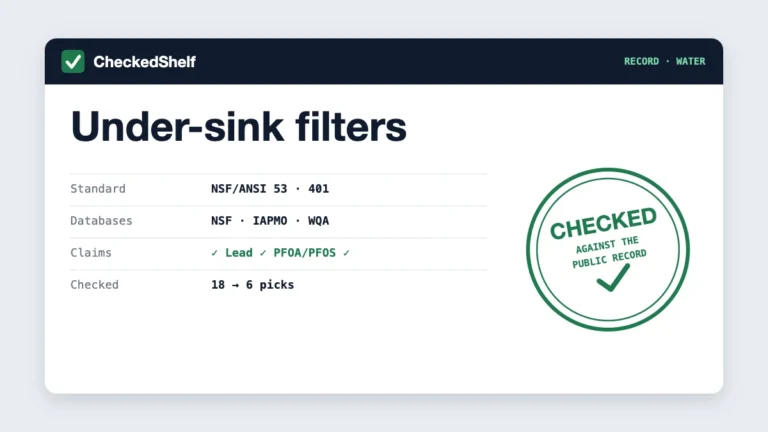
 18 checked → 6 picksBest 6 Under-Sink Water Filters of 2026 (Checked Against NSF/ANSI 53 Listings)Records checked Nov 19, 2026
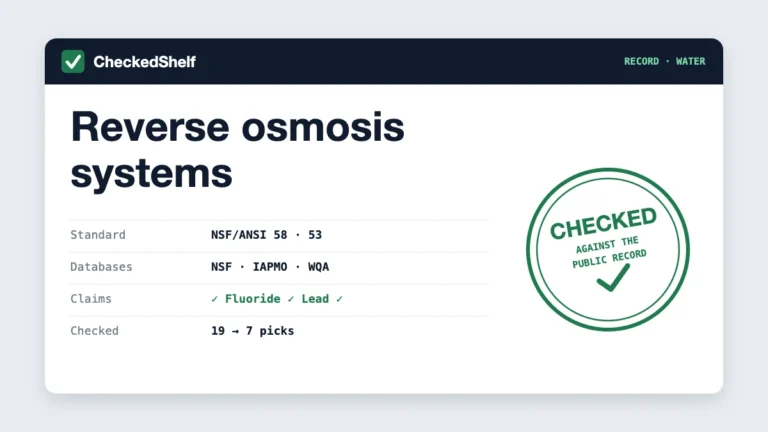
- 19 checked → 7 picksBest 7 Reverse Osmosis Systems of 2026 (Checked Against NSF/ANSI 58 Listings)Records checked Nov 19, 2026
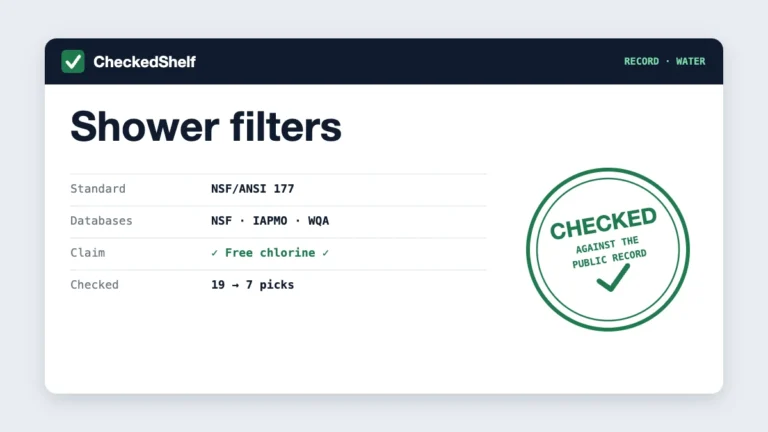
- 19 checked → 7 picksBest 7 Shower Filters of 2026 (Checked Against NSF/ANSI 177 Listings)Records checked Nov 19, 2026